Google Docs
Publish date: Nov 14, 2021Tags: Programming
library(googlesheets4)
library(sf)
library(opencage) # for geocoding addresses
library(usethis)
library(hrbrthemes) # hrbrmstr/hrbrthemes
library(tidyverse)
library(kableExtra)
library(rnaturalearth)
library(tmap)
library(ggthemes)

# usethis::edit_r_environ() # add Opencage API to your .Renviron file

# Add a line OPENCAGE_KEY="xxxxxxxxxxxxxxxxxxxxxxxxxxxxxxx"
# Before you exit, make sure your .Renviron ends with a blank line, then save and close it.
# Restart RStudio after modifying .Renviron in order to load the API key into memory.
# To check everything worked, go to console and type
# Sys.getenv("OPENCAGE_KEY")


googlesheets4::gs4_auth() # google sheets authorisation

#load countries_visited googlesheets
countries_visited <- read_sheet("https://docs.google.com/spreadsheets/d/14k4xrwrMRfabnyqQ2y_mTNdf-gT5KBDMAAS42H44V7E/edit?usp=sharing
")

geocoded <- countries_visited %>%
  mutate(
    address_geo = purrr::map(country, opencage_forward, limit=1) # the beauty of purrr:map()
  ) %>%
  unnest_wider(address_geo) %>% # opencage returns a list, hence we unnest it...
  unnest(results) %>% # look inside the results that opencage returns
  rename(lat = geometry.lat, # rename latitude/longitude to lat/lng
         lng = geometry.lng) %>%
  select(country, lat, lng) # just select country, latitude, longitude

geocoded %>%
  kable()%>%  # print a table with geocoded addresses
kable_styling(bootstrap_options = c("striped", "hover", "condensed", "responsive"))| country | lat | lng |
|---|---|---|
| Argentina | -34.996496 | -64.967282 |
| Austria | 47.593970 | 14.124560 |
| Belgium | 50.640281 | 4.666715 |
| Bulgaria | 42.607397 | 25.485662 |
| Canada | 61.066692 | -107.991707 |
| China | 35.000074 | 104.999927 |
| Cyprus | 34.982302 | 33.145128 |
| Czechia | 49.816700 | 15.474954 |
| Denmark | 55.670249 | 10.333328 |
| France | 46.603354 | 1.888334 |
| Germany | 51.083420 | 10.423447 |
| Greece | 38.995368 | 21.987713 |
| Italy | 42.638426 | 12.674297 |
| Liechtenstein | 47.141631 | 9.553153 |
| Mexico | 23.658512 | -102.007710 |
| Monaco | 43.732349 | 7.427683 |
| Nigeria | 9.600036 | 7.999972 |
| Portugal | 40.033263 | -7.889626 |
| Spain | 39.326068 | -4.837979 |
| Sweden | 59.674971 | 14.520858 |
| Switzerland | 46.798562 | 8.231974 |
| Tunisia | 33.843941 | 9.400138 |
| Turkey | 38.959759 | 34.924965 |
| United Arab Emirates | 24.000249 | 53.999483 |
| United Kingdom | 54.702354 | -3.276575 |
| United States of America | 39.783730 | -100.445882 |
# we will use the rnatural earth package to get a medium resolution
# vector map of world countries excl. Antarctica
world <- ne_countries(scale = "medium", returnclass = "sf") %>%
  filter(name != "Antarctica")

st_geometry(world) # what is the geometry?
## Geometry set for 240 features
## Geometry type: MULTIPOLYGON
## Dimension: XY
## Bounding box: xmin: -180 ymin: -58.49229 xmax: 180 ymax: 83.59961
## CRS: +proj=longlat +datum=WGS84 +no_defs +ellps=WGS84 +towgs84=0,0,0
## First 5 geometries:# CRS: +proj=longlat +datum=WGS84 +no_defs +ellps=WGS84 +towgs84=0,0,0
ggplot(data = world) +
geom_sf() + # the first two lines just plot the world shapefile
geom_point(data = geocoded, # then we add points
aes(x = lng, y = lat),
size = 2,
colour = "#001e62") +
theme_void()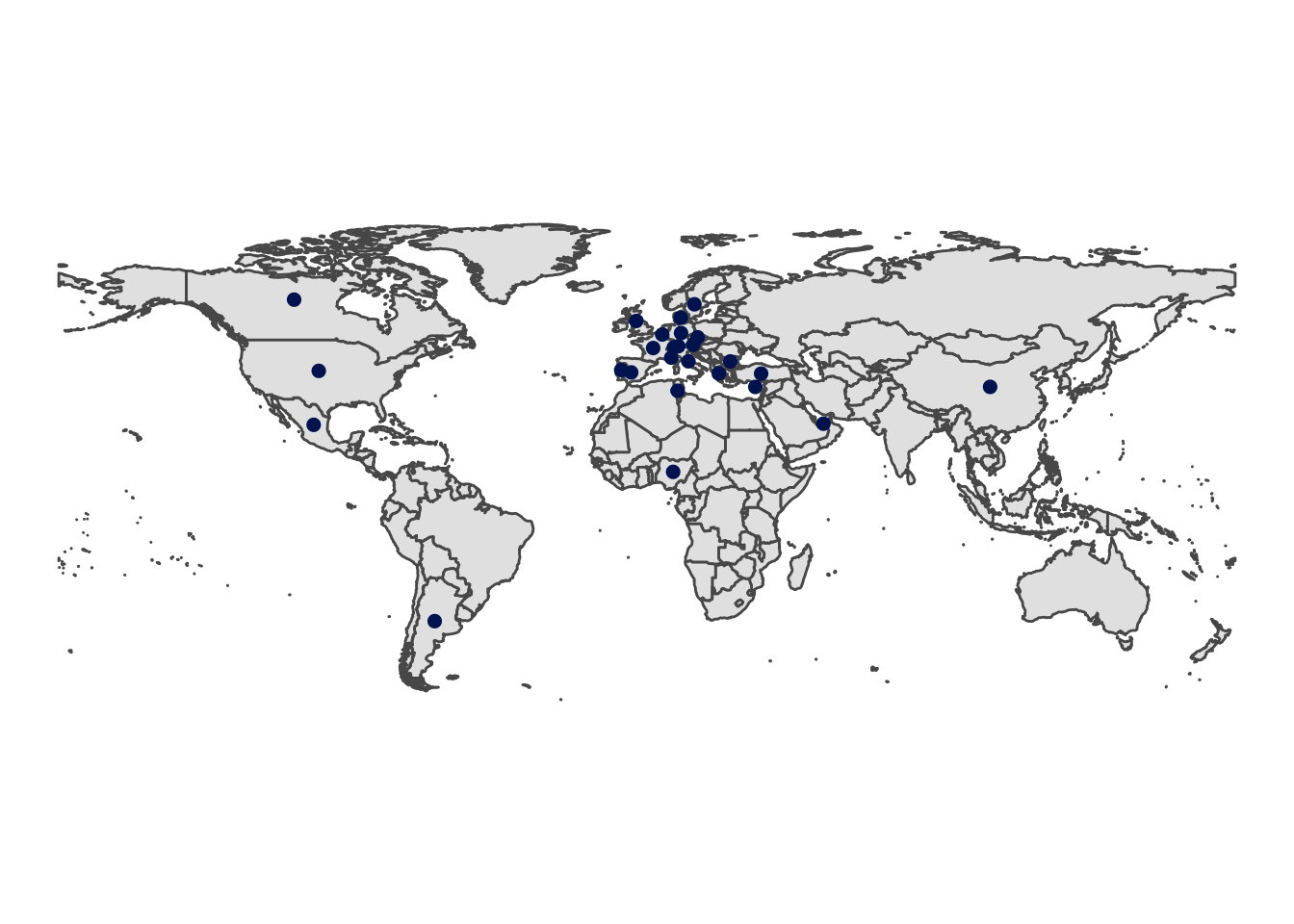
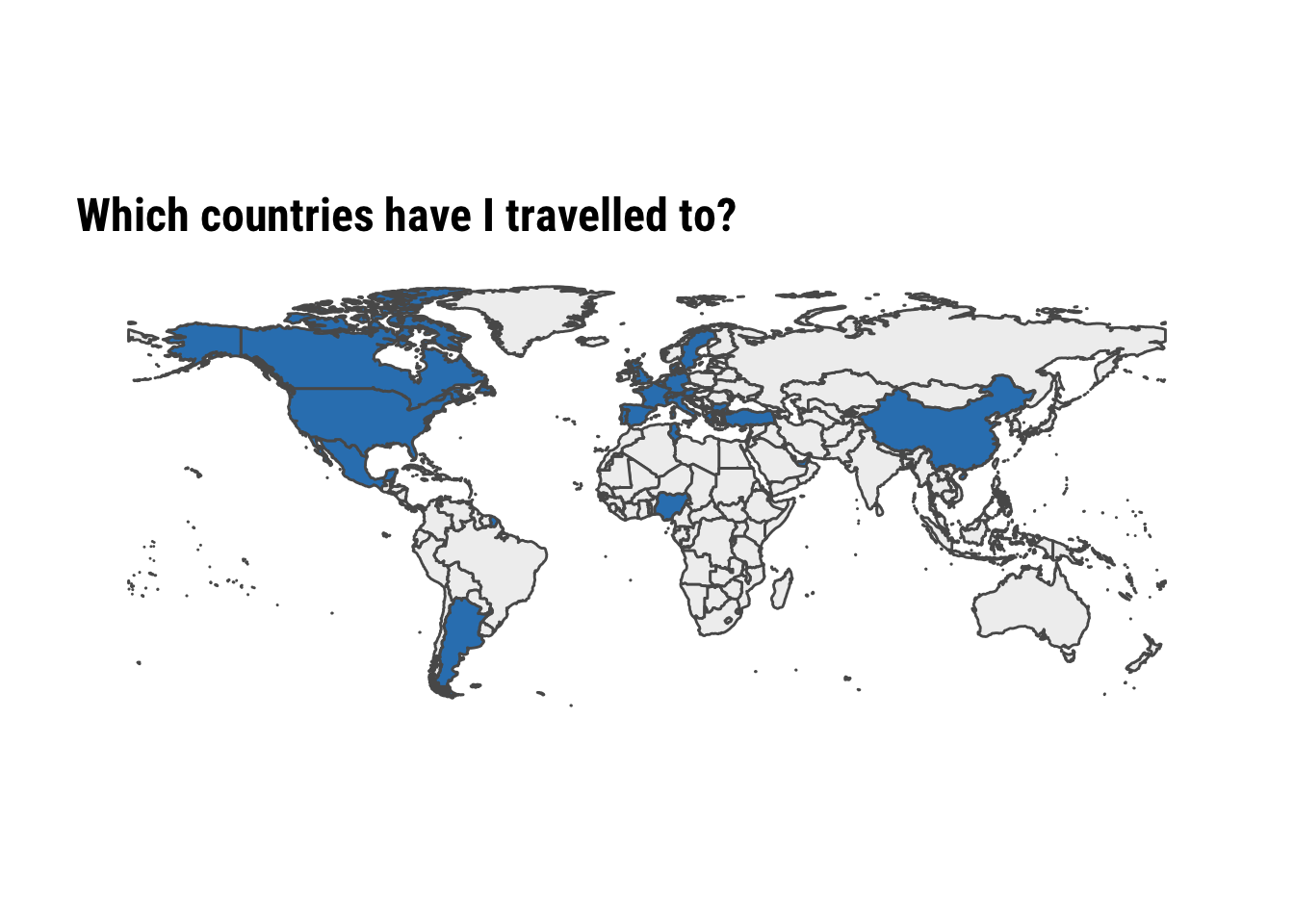
world_visited <- left_join(world, geocoded,  by=c("admin" = "country" )) %>%
    mutate(visited = if_else (!is.na(lat), "visited", "not visited")
  )

ggplot(world_visited)+
  geom_sf(aes(fill=visited),
          show.legend = FALSE)+    # no legend
  scale_fill_manual(values=c('#f0f0f0', '#3182bd'))+
  coord_sf(datum = NA) +
  theme_void()+
  labs(title="Which countries have I travelled to?")+
  theme_ipsum_rc(grid="", strip_text_face = "bold") +
  NULL